
Public exhibition
The public exhibition initiated a consultation period being run by RES to gather comments on the proposal. The closing date for comments was February 2023.
All information provided at the public exhibition is available to view below.
About the project
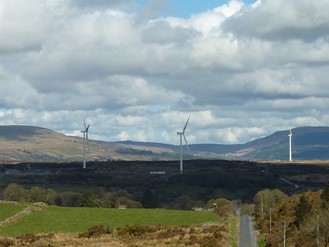
RES is currently consulting on its plans for a proposed wind farm called Carnbuck located in the townlands of Carnbuck, Magheraboy and Moneyneagh, near Corkey, Co. Antrim, adjacent to the existing Gruig Wind Farm.
Carnbuck Wind Farm has been designed to generate reliable, renewable electricity, whilst minimising local impacts and maximising local benefits wherever possible.
The wind farm would be capable of generating around 50 megawatts (MW) of clean, green, low-cost renewable electricity. Equivalent to the electricity usage of around 55,0001 homes each year.
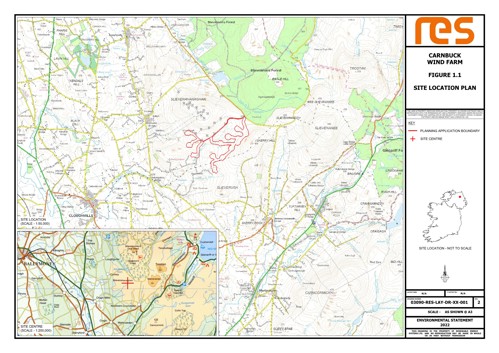
Click on image to enlarge
Design layout and infrastructure
The wind farm proposal is for 12 turbines up to 180m in height.
The proposed wind farm would share a site entrance and some infrastructure with Gruig Wind Farm, reducing the environmental footprint and traffic movements.
The layout has been developed in response to feedback from stakeholders and the community along with the results of numerous environmental surveys that have been undertaken.
In addition to high-level necessities such as good wind-speeds, we have considered a number of site-specific features and buffers. These include turbines being located more than 1km from nearest properties, 50m from major watercourses and 10m from minor watercourses, and avoidance of areas of ecological interest and prominent hilltops.
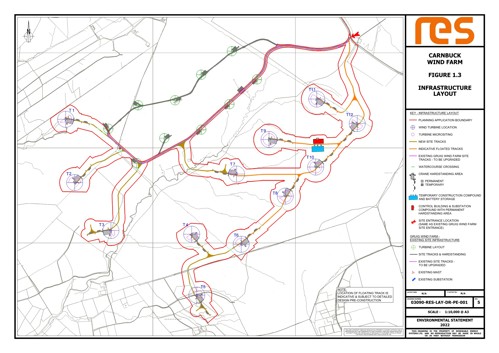
Click on image to enlarge
Environmental considerations
As part of the planning process, RES undertakes an Environmental Impact Assessment (EIA). The purpose of the EIA is to investigate and alleviate any potential effects of a development on the natural, physical and human environment. An EIA includes the following assessments:
- Ecology
- Ornithology
- Fisheries
- Hydrology
- Geotechnical
- Landscape and visual
- Archaeology and cultural heritage
- Socioeconomic
The results of these surveys will be included in the Environmental Statement which will form part of any planning application that is submitted.
What would the Wind Farm look like?
We have produced indicative visualisations to help give an impression of what the wind farm could look like from different viewpoints in the area. Click on the links below to view.
- Corkey Village at Reservoir Road junction
- Corkey Village at Ballyweeny Road junction
- Junction of Ballyweeny and Ballyveely Roads
- Omerbane Road near Tullykittagh Road
- Skerry West at Omerbane Road junction
- Dunloy Village
- Killygore Road near A43 at Martinstown
- Old Cushendun Road to north of Altnahinch Road
We have also produced indicative Zone of Theoretical Visibility (ZTV) Maps showing where the turbines could be visible from. Please note that this is based on bare land form without taking into account any screening effects of trees and buildings.
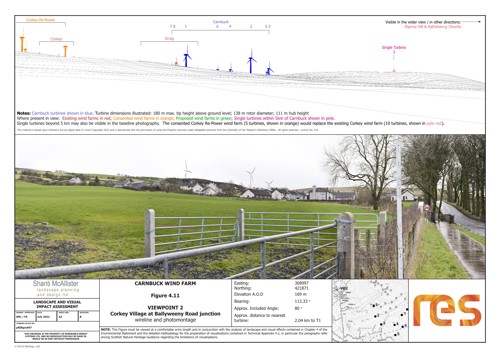
Click on the image to enlarge
Traffic and transport
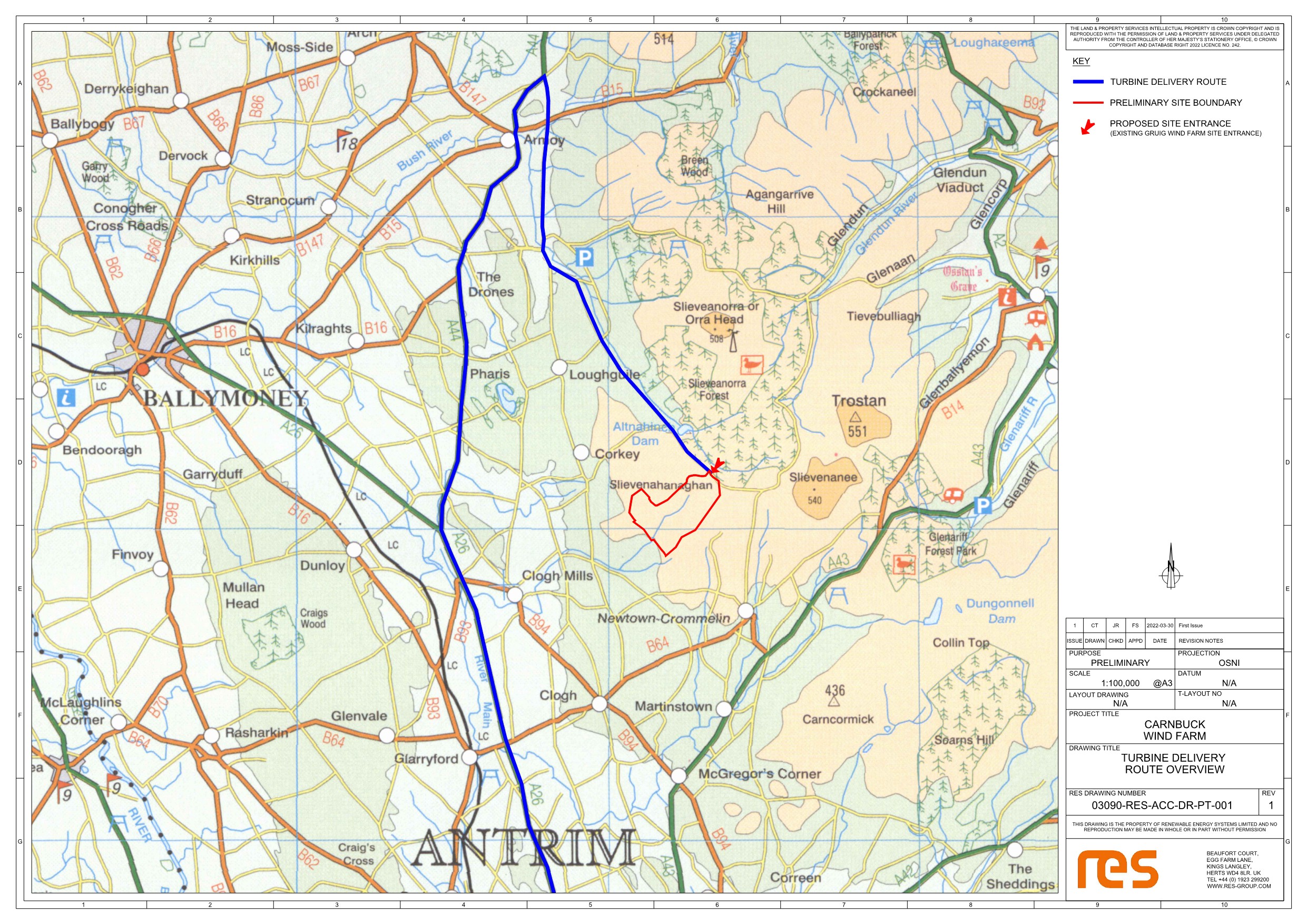
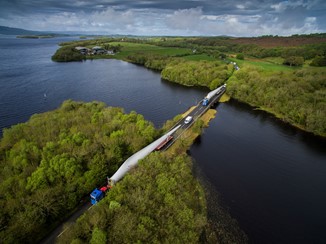
Access is one of the key considerations when selecting a potential wind farm site, particularly with regard to the turbine deliveries.
The preferred access point and turbine delivery route are shown on the map to the right.
A transport assessment will be undertaken as part of the Environmental Impact Assessment (EIA) process and, if the wind farm is given consent, a detailed Traffic Management Plan will be agreed with the highways authorities and the police, and in consultation with the local community.
Wherever reasonably practicable we will use materials available on site and source construction materials locally in order to help reduce traffic movements.
Click on image to enlarge
Noise
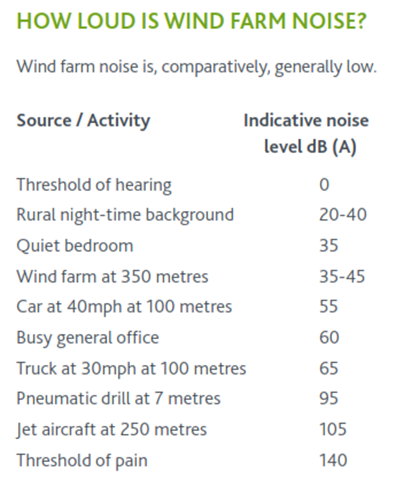
Wind farm noise in many circumstances may be inaudible or effectively "masked" by the background noise already present in the surrounding environment.
We take care to ensure noise levels from wind turbines are within recommended limits and comply with planning policy.
For Carnbuck Wind Farm we have undertaken a noise impact assessment in accordance with relevant guidance and in consultation with the local council's Environmental Health Department.
The results from these surveys enables us to gain an understanding of the existing noise environment and feed into the design of the wind farm. As a result of the existing background noise levels and the distances from surrounding properties, the proposed wind farm will comply with the relevant guidance on wind farm noise.
Supply chain opportunities
RES has a strong track-record of working closely with the local supply chain around its projects and maximising inward investment opportunities wherever possible.
Carnbuck Wind Farm has the potential to deliver approximately £3.3 million to the local area in the form of jobs, employment, and the use of local services.
RES is keen to hear from local businesses who are interested in learning more about the opportunities associated with the construction and operation of this project.
During the construction of Castlecraig Wind Farm, near Drumquin, over £3 million inward investment was realised into the local economy. The wind farm construction also provided employment for around 50 local people.
The construction of Altaveeden Wind Farm, near Loughguile was an economic success for local area, with £1.3 million invested directly into Co. Antrim with £772,000 of this spent within 5 miles of the site. A number of local contractors were used including P. Keenan and Sons, F.P. McCann and William and Henry Alexander (Civil Engineering) Limited.
Why wind?
- Wind is a free and inexhaustible resource which has an important role to play as part of a balanced energy mix.
- Tackling Climate Change by supporting Northern Ireland's Climate Bill, which has a target of 80% of electricity consumption from renewables sources by 2030.
- Can be quick to deploy.
- Onshore wind, alongside largescale solar and offshore wind are now the cheapest forms of new electricity generation2.
- Enables us to generate our own electricity reducing reliance on imports and improving security of supply.
- Northern Ireland consumers avoided paying £500 million to import gas last year because wind farms provided nearly 42% of our electricity3.
RES in Northern Ireland
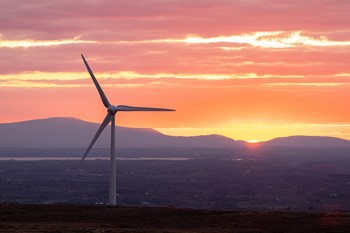
RES has been playing a pivotal role in providing Northern Ireland with renewable energy since the early 1990s.
Working together with businesses based in Northern Ireland our projects contribute to the local economy and utilise our home-grown energy sources.
With the urgent need to escalate decarbonisation, RES remains committed to being part of Northern Ireland's energy future and business growth, through maximising contributions from renewable energy.
1 The homes figure has been calculated by taking the predicted annual electricity generation of the site (based on RES assessments Carnbuck has a predicted capacity factor of 46.75%) and dividing this by the annual average electricity figures from the Department of Business, Energy and Industrial Strategy (BEIS) showing that the annual UK average domestic household consumption is 3,748 kWh (Dec 2021).
2 https://assets.publishing.service.gov.uk/media/6556027d046ed400148b99fe/electricity-generation-costs-2023.pdf
3 https://renewableni.com/wind-saves-ni-500m-in-2022